
How to Set Up the 837 Export in StoriiCare
StoriiCare can generate 837 claims for U.S. insurers, so you don't have to type claims into each payer portal. Billing gets faster and more accurate.
🔌 How Claim Submission Works
Stedi (recommended): StoriiCare connects to Stedi through an API. You submit claims straight from StoriiCare, with no files to download or upload.
Availity, Change Healthcare, Optum and others: You export the 837 file from StoriiCare, then upload it to your clearinghouse's portal.
Before you begin, check out these two articles for more background:
⚠️ Screenshots in this guide use dummy values. Replace every field with your own agency, participant and payer information.
🔧 Step 1: Center-Specific Setup
Go to: Billing > Settings > Exports > 837s Export > Center Specific
Every field is required except the two Secondary Submitter fields.
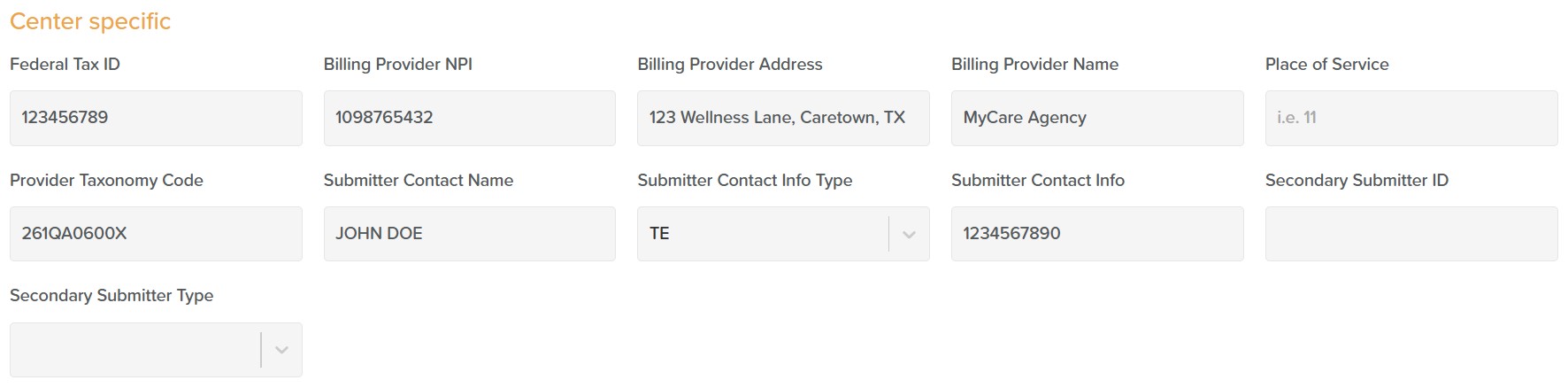
Field | What to enter | Example | Where to find it |
|---|---|---|---|
Federal Tax ID | Your EIN: 9 digits, no dashes | 123456789 | IRS EIN letter (CP 575), W-9, or your accountant |
Billing Provider NPI | Your organizational (Type 2) NPI: 10 digits | 1098765432 | |
Billing Provider Address | One line in this order: Street, City, State ZIP. Separate the parts with commas and don't use any other commas. No other special characters and no PO Boxes. | 123 Wellness Lane, Caretown, TX 75001 | NPPES record or enrollment paperwork |
Billing Provider Name | Your legal name, exactly as listed in NPPES | MyCare Agency | NPPES record (should match your IRS EIN letter) |
Place of Service | Two-digit code for where services take place. 99 is the most common code for StoriiCare centers (see below). | 99 | Your payer's billing manual or contract |
Provider Taxonomy Code | 10-character code. Adult day centers often use 261QA0600X. | 261QA0600X | NPPES record, under "Taxonomy" |
Submitter Contact Name | The person payers should contact about claims | John Doe | Your billing lead |
Submitter Contact Info Type | TE (Telephone, recommended), EM (Email) or FX (Fax). Some payers reject claims without a phone number. | TE | — |
Submitter Contact Info | For TE or FX: 10 digits, digits only. For EM: a business email address. | 1234567890 | Your center's business line or billing inbox |
Secondary Submitter ID / Type (optional) | Leave blank unless your payer or clearinghouse asks for it | — | Payer or clearinghouse instructions |
💡 Why 99? The CMS Place of Service list has no code for adult day centers. Code 99 means "Other Place of Service," so most centers use it. If your payer requires a different code, use theirs.
👤 Step 2: Participant-Specific Setup
Go to: Billing > Settings > Exports > 837s Export > Participant Specific
Map each 837 field to the matching field in StoriiCare. Most centers keep insurance details in the Face Sheet > Admin Summary, where sensitive information usually lives. You can map to any Face Sheet field, though, so use wherever your center stores the data.
⚠️ Optional fields may still be required by your state or payer.

Field | Status | What it is | Where to find it |
|---|---|---|---|
Policy/Insurance ID | Required | The participant's member ID | Insurance card ("Member ID" or "Medicaid ID") |
Insurance Type | Required | Type of coverage (codes below) | Insurance card or payer contract |
Participant Address | Required | Home address in this format: Street, City, State ZIP. Use commas only to separate the parts, with no other special characters and no PO Boxes. | Intake forms (should match the insurer's records) |
Group/Plan Number | Required | The participant's specific plan or group | Insurance card ("Group #"). If there isn't one, check with the payer. |
Prior Authorization Code | Required | The payer's approval number for services | Authorization letter from the payer, MCO or case manager |
Primary Problem Code (ICD-10) | Required | The main diagnosis supporting the need for services | Physician orders, medical records or the authorization |
Admission Date | Optional | The date the participant started services | Your enrollment records |
Referring Provider + NPI | Optional | Who referred the participant to you | Referral form |
Ordering Physician + NPI | Optional | Who signed the order for services | Physician order or plan of care |
Attending Physician + NPI | Optional | Who oversees the participant's overall care | Intake or physician information forms |
Facility Type Code (837I only) | Optional | Two-digit facility + bill type code. For example, 13 = Hospital + Outpatient. | Your payer's billing manual |
Insurance Type codes:
MC: Medicaid
GR: Group Health Plan
VA: Veterans Affairs Plan
CI: Commercial Insurance Co. (General private health insurance)
HM: Health Maintenance Organization (HMO)
MA: Medicare Part A
MB: Medicare Part B
WC: Workers' Compensation Health Claim
⚠️ Setting up physician NPIs
To map a physician's NPI, it first has to be saved as a custom field on that physician's contact record in StoriiCare:
Open the physician's contact record and add a custom field (for example, "NPI").
Enter their 10-digit NPI. You can look it up by name in the NPPES NPI Registry.
Back in Participant Specific setup, map the NPI field to that custom field.
If one physician fills more than one role (referring, ordering, attending), use the same contact record for each.
🏥 Step 3: Payer Setup
Go to: Billing > Payers > Create New Payer > Agency > Claim Settings
With Stedi, you only fill in two fields. Pick the payer from the dropdown and enter your Payer Linked Sender ID. The StoriiCare–Stedi integration fills in the rest automatically when you submit.

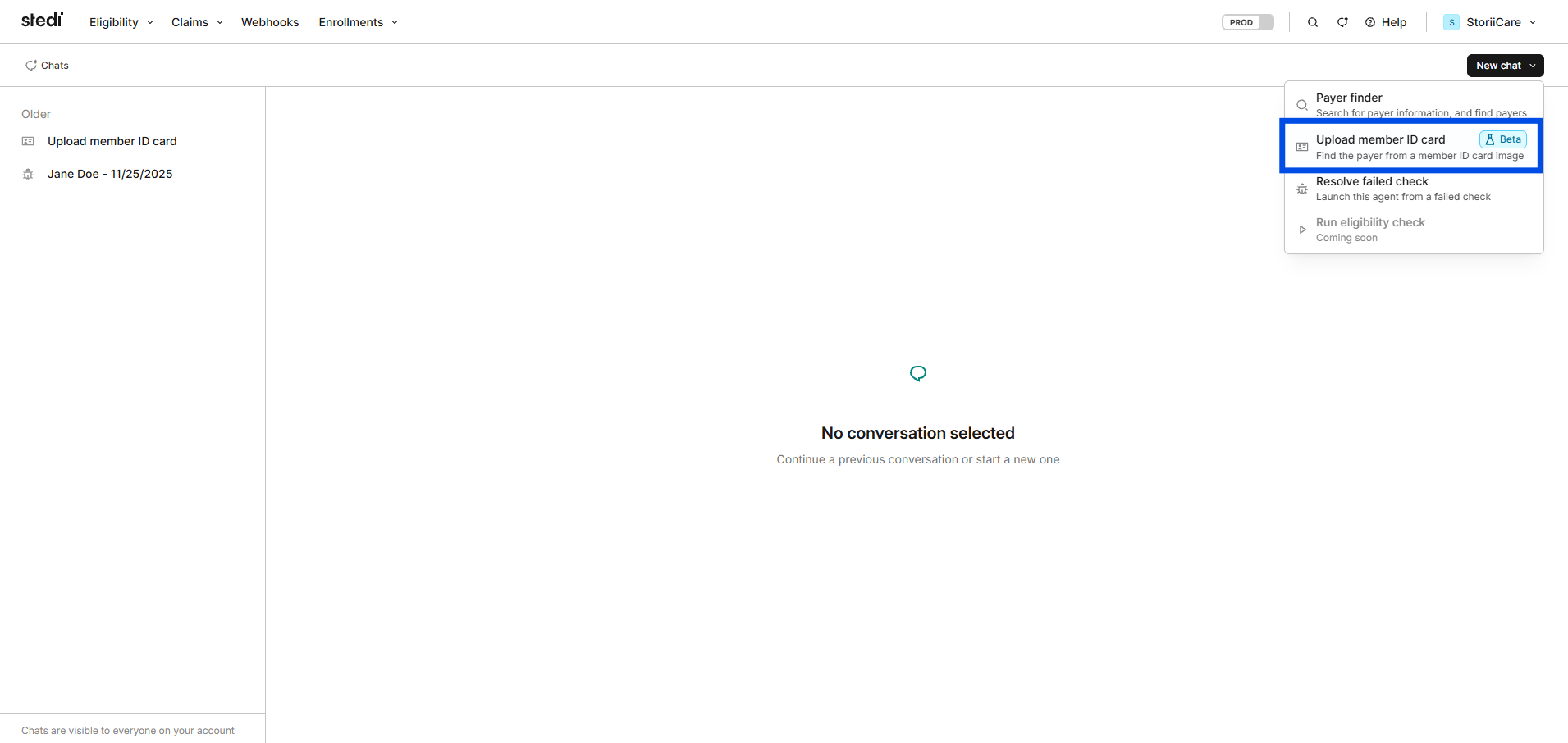
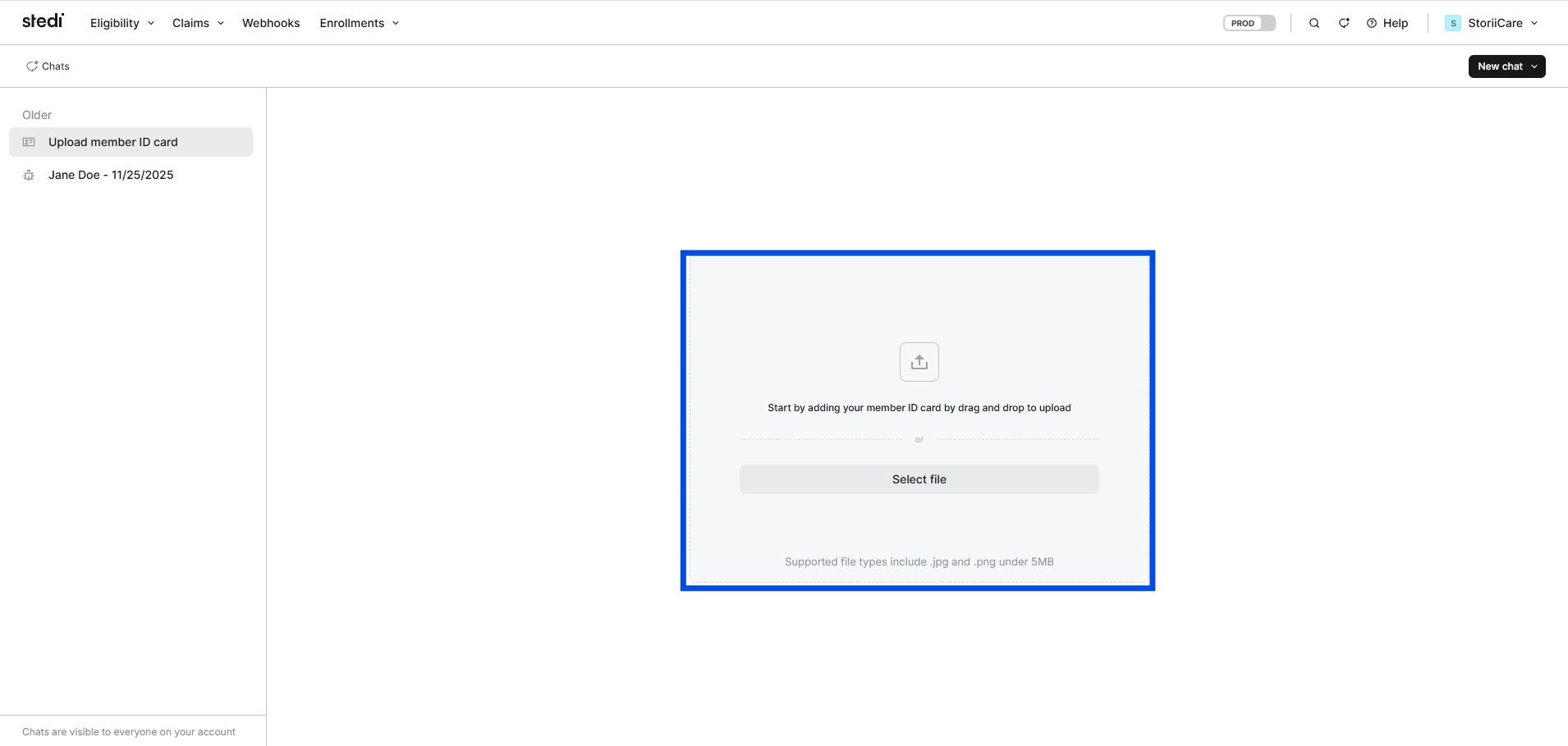
If you don't know the Payer ID, in Stedi, you can also click New chat and upload a photo of the participant's insurance card to find the matching Payer ID. For other clearinghouses, check their payer list.
Here is an example for Availity. If this is your clearinghouse, you can use the exact same values in this example for every payer you create, except the Payer ID.

Field | What it is | Stedi | Availity (example) | Where to find it |
|---|---|---|---|---|
Payer ID | Tells the clearinghouse which insurer gets the claim. Each clearinghouse uses its own Payer IDs, so the same insurer can have different IDs in Stedi and Availity. | Select from the dropdown (e.g., HMSA (100937)) | TWVACCN | The participant's insurance card. Then find the matching ID in your clearinghouse's payer list. |
Interchange ID Qualifier (ISA07) | Tells the system what kind of ID is in Claims Receiver ID | Leave blank (auto-filled as ZZ) | 01 | Your clearinghouse's EDI connection guide |
Acknowledgment Requested (ISA14) | Asks for a "we got your file" receipt. 1 = Yes, 0 = No. | Leave blank (auto-filled) | 1 | Always enter 1 so you know your claims arrived |
Claims Receiver ID | Who receives the claim file first: the clearinghouse, not the insurer | Leave blank (auto-filled as STEDI) | 030240928 | Your clearinghouse's EDI connection guide |
Payer Full Address | The insurer's mailing address. Electronic claims don't need it. | Leave blank | Leave blank | — |
Payer Linked Sender ID | Tells the insurer who sent the claim. Getting this ID is your center's responsibility. | Enter your Submitter ID or Tax ID | AV09311993 | You get this ID from your payer, usually when you contract or credential with them (Iowa Medicaid IDs, for example, start with "IA"). Stedi and other clearinghouses don't have it. If your payer didn't assign one, use your Federal Tax ID. |
Using another clearinghouse? Ask it for its Payer ID, ISA07 and Claims Receiver ID values.
✅ You're Done!
Go to Bulk Invoice Actions and select the invoices you want to bill:
Stedi: Submit directly from StoriiCare.
Other clearinghouses: Generate the 837 export, download it, and upload it to your clearinghouse.
Questions? Feel free to reach out to the StoriiCare team or share this article with your billing staff.