
Creating a Point-Based Assessment (Matrix Calculator)
The Matrix Calculator component allows clients to create custom scoring systems within forms or assessments on StoriiCare. This is especially valuable for screeners, intakes, and risk assessments where scores are generated based on selected responses.
The Matrix Calculator is a powerful tool designed to support structured data collection and risk identification. When configuring clinically relevant scoring systems or calculations, it is essential that forms are designed in a way that is transparent, evidence-based, and supports professional judgement.
Why Use the Matrix Calculator?
• Enables creation of dynamic scoring systems within forms
• Supports custom logic and score-based responses
• Perfect for ever-changing assessment needs across regions
• Empowers care teams to experiment with new processes quickly and easily
Evidence-Based Scoring Systems
Where a Matrix Calculator is used to configure a clinically relevant scoring system or calculation, organizations should ensure that:
The scoring system is evidence-based, widely used, and recognised as best practice
The evidence base or source for the scoring system is displayed within the form itself
Configurations are limited to:
Simple additive scoring systems (points allocated to responses and added together), or
Simple calculations that an end user could independently verify using a basic calculator
Complex, opaque, or proprietary algorithms should not be recreated within Form Builder.
Getting Started
To use the Matrix Calculator:
1. Open the Form Builder feature.
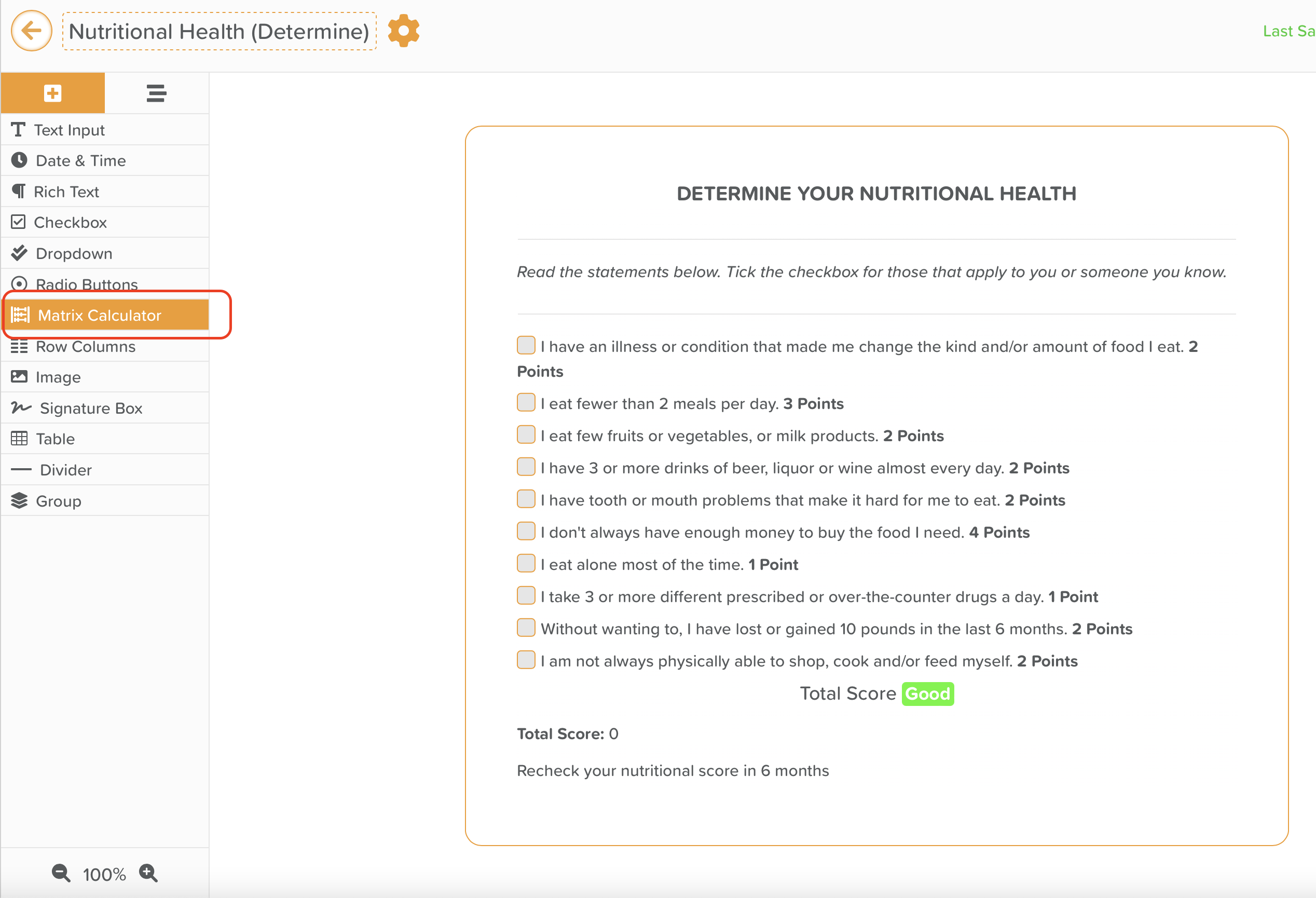
2. Drag the Matrix Calculator component into your form canvas.
• This can be a new form or an existing one.
Supported Components for Scoring
You can assign point values to the following components:
• Radio Buttons (single-select)
• Checkboxes (multi-select)
• Dropdown Selections (single or multi-select)
Once the Matrix Calculator is on your canvas, connected components will display point values.
Note: To exclude a component from the score calculation:
• Click on the component
• Select the settings wheel icon
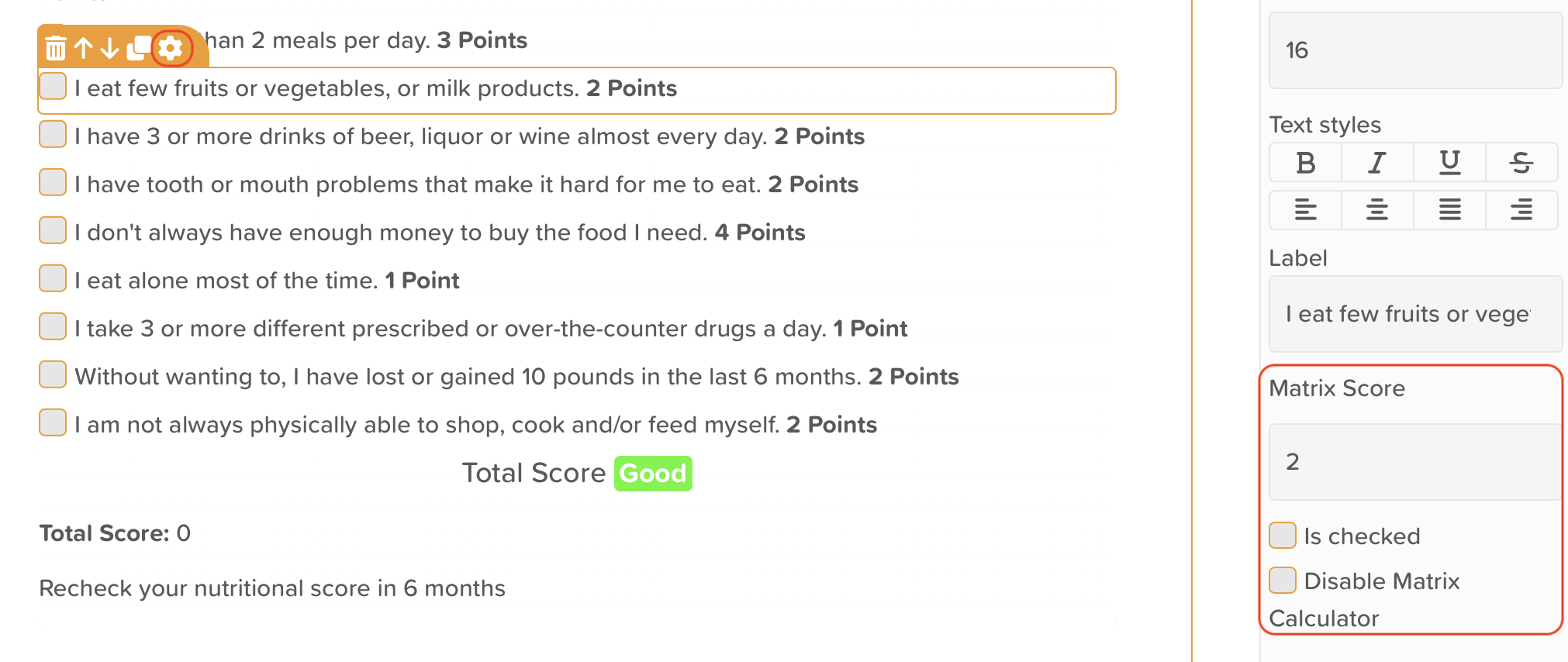
• Check the box labeled “Disable Matrix Calculator”
How to Assign Point Values
To assign or update point values:
1. Click on the component (e.g. checkbox, radio button, or dropdown).
2. Select the settings wheel icon.
3. Enter your value in the Matrix Score field.
How to Create a Scoring System
After assigning point values to components:
1. Drag the Matrix Calculator into your form.
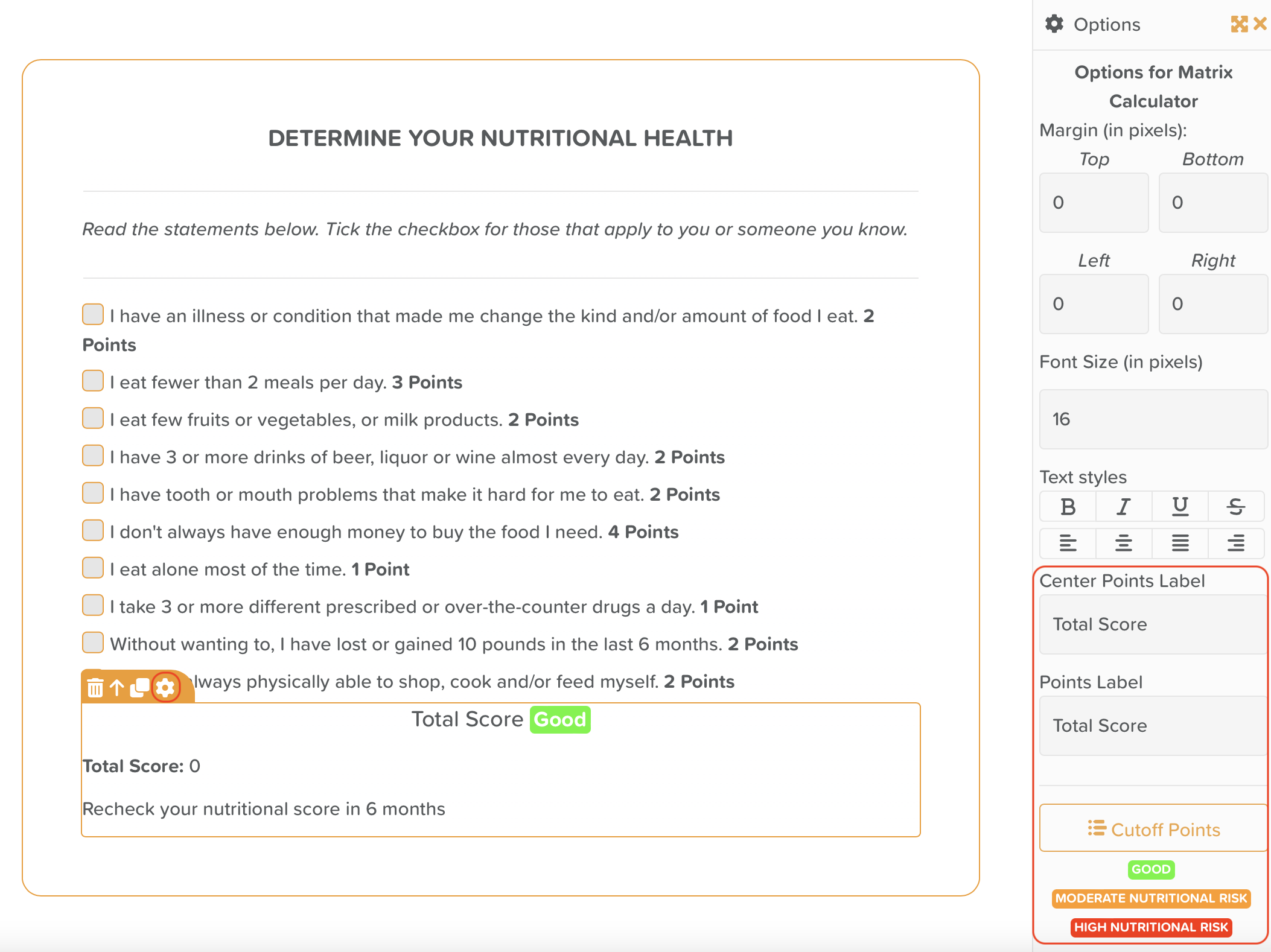
2. Click the settings wheel icon on the Matrix Calculator.
3. In the Options panel, configure:
• Center Points Label (e.g. “Total Score”)
• Points Label (e.g. “Final Score”)
4. Click on the Cutoff Points button to define scoring logic and labels (e.g. “High Risk”, “Low Risk”).
Configuring Cutoff Points
To customize your scoring logic and results:
1. Click the Cutoff Points button in the Matrix Calculator’s options panel.
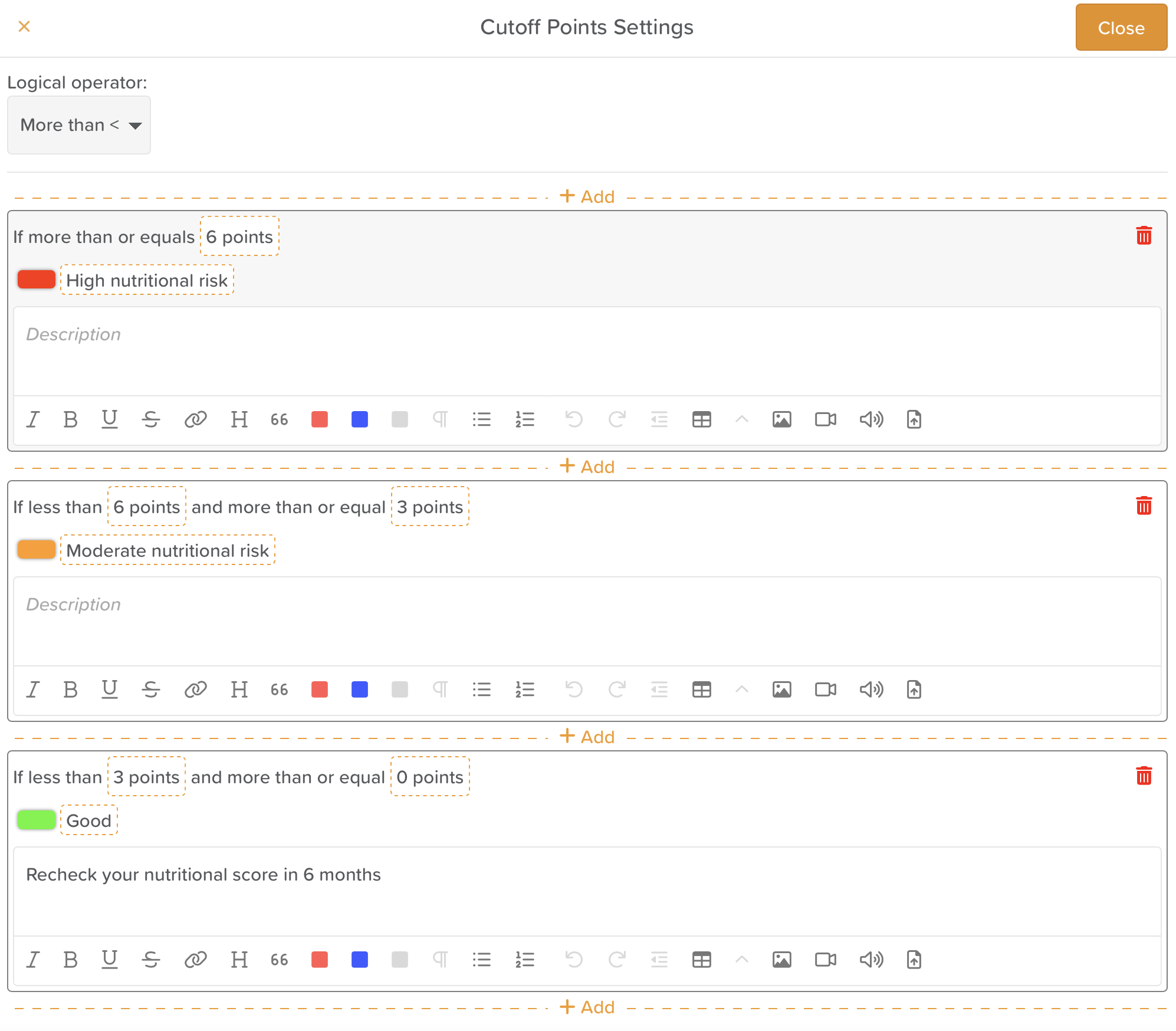
2. Configure the following settings:
• Logical operator (e.g. More than, Less than)
• Score thresholds for each badge
• Custom badge labels (e.g. “High Risk”)
• Badge colors
• Custom descriptions for each badge result
Tip: Descriptions use a rich text editor, allowing:
• Formatted text
• Images and videos
• YouTube embeds
• File uploads
These badges will appear dynamically based on the generated score.
Use Clear Labels and Color Coding (Two Methods Required)
Users configuring forms should:
Use both COLOR and TEXT to indicate the significance of a result or band.
Provide clear, unambiguous labels (e.g., High Risk – Immediate Action Required).
Color alone must never be the only indicator, ensuring accessibility for users with visual impairments.
Where Scoring Badges Display
If a score badge is generated when a form is completed:
• It will appear alongside the form results.
• It will also display automatically under the Assessment Scores section in the Face Sheet / Care Overview for that Participant.
Provide an Overview of All Risk Bands and Associated Prompts
If your scoring system generates a risk band (e.g., low/medium/high) and displays unique prompts or guidance based on that band:
Your form must also present an overview of all possible bands, including the meaning of each band and any associated prompts.
This ensures end-users can interpret the score holistically and exercise appropriate professional judgment when deciding on next steps.
Compliance Checklist for Scoring Systems & Calculations
Use this quick-reference checklist to ensure all configured forms, scoring systems, and matrix calculators meet compliance, safety, and documentation standards. More detailed explanations of these Compliance Considerations are in the following section.
Form Structure & Transparency
All risk bands and associated prompts are displayed so users can interpret every possible outcome.
Use both COLOR and TEXT to indicate the significance of a result or band.
(e.g. “High Risk – Immediate Review Required”)
All calculated outputs are clearly labeled with appropriate units of measure.
The date of calculation is captured in the form.
A free text box is included for staff to document additional observations.
All fields used in the calculation are mandatory to prevent incomplete scoring.
Scoring Method & Raw Data
Raw data used in the calculation is visible to end-users.
The formula or methodology used to derive the score is visible or clearly documented.
Units of measure (e.g. kg, cm, bpm) are specified for each clinical field or selectable by the end-user.
All fields that contribute to a calculated score must be configured as mandatory.
Clinical Validity & Safety
Scoring system or calculator is evidence-based, widely accepted, and considered best practice.
Citation or evidence base is displayed within the form.
Only simple, verifiable scoring systems are used (e.g., additive scores or basic calculations).
Clinical questions do not use default responses—each requires an intentional staff input.
Documentation Integrity
Form layout, labels, and prompts support clarity and correct interpretation.
No automated scoring is presented without context or supporting explanation.
End-users can independently validate the calculation if desired.
Compliance Considerations When Configuring Calculations and Scoring Systems
When using Form Builder to create scoring systems, matrix calculators, or automated outputs, forms must adhere to clinical, legal, and ethical documentation standards. The following compliance guidelines help ensure that calculations are transparent, interpretable, safe, and aligned with best practices.
Label Calculated Outputs Clearly & Include Units of Measure
For every calculated value:
Provide a clear title or label explaining what the number represents.
Ensure the correct units of measure are displayed (e.g., kg, cm, bpm, mmol/L).
Include a date field in the form so the date of calculation is always recorded.
Add a free text box to allow staff to document contextual observations or clinical impressions.
This ensures that scores are interpreted appropriately and not taken in isolation.
Ensure All Calculation Inputs Are Mandatory
To avoid incorrect or incomplete scoring:
All fields used in a calculation or scoring system should be configured as mandatory.
A score should never be generated from partial or missing data.
See: How to Set a Field as 'Required' in a Form
Ensure Visibility of Raw Data and the Scoring Methodology
Users configuring scoring systems must ensure:
The raw data used in the calculation is visible within the form.
The formula or scoring method is also visible or otherwise documented.
This transparency allows end-users to manually verify the calculation if desired, increasing trust and accuracy.
Use Only Evidence-Based, Widely Accepted Scoring Systems
When configuring clinically relevant scoring tools using the Matrix Calculator:
Only use scoring systems that are evidence-based, widely used, and considered best practice.
Include the evidence base or citation directly within the form.
Limit configurations to simple scoring or calculations that can be replicated with a basic calculator if needed.
(e.g., simple additive scores, basic ratio calculations)
Complex or proprietary algorithms should not be created within Form Builder.
Avoid Default Responses for Clinical Questions
When building forms intended to capture clinical information, such as:
Symptoms
Medical history
Behaviour
Mood
Pain
Functional abilities
Users must avoid using default responses.
All clinical questions should require an active, intentional response to:
Prevent inadvertent incorrect data capture
Ensure accuracy and reliability
Support regulatory compliance
Need More Help?
If you need further assistance, you can reach out to our support team by emailing support@storii.com. Our support team is ready to help you with any questions or issues you may have.