
A Guide to Payments
StoriiCare Payments lets you collect and track payments for your invoices in one place. Payers can pay online through a secure payment link, by card, bank account or Google Pay. You can also record payments received outside StoriiCare, such as checks, cash or Zelle. Every payment is matched to its invoice, so participant and payer balances stay up to date.
How Payments Work
There are two ways a payment gets into StoriiCare:
Online payments: The payer pays through StoriiCare’s payment page using a link, QR code or invoice PDF. The payment is processed through Stripe, recorded automatically and deposited into your bank account.
Manual payments: You record a payment received outside StoriiCare, such as a check, cash, ACH from an agency, or a payment through Venmo, Cash App or Zelle. Manual payments are for tracking only, so you still need to deposit checks and cash with your bank.
Online payments are available in the following countries and their currencies:
United States
Canada
Mexico
United Kingdom
Ireland
Malta
Australia
Malaysia
Indonesia
If you’d like to use StoriiCare Payments in a country not listed, please contact support@storii.com.
Setting Up Online Payments
To accept online payments, complete payment processing onboarding through Stripe.
Go to Billing and select the Settings tab.
Open Payments and expand Payments Setup.
Follow the onboarding steps. You’ll be asked for your business details, tax information, details of an authorized representative, and the bank account where you want to receive payouts.
Once onboarding is complete, Payments Setup shows You have completed billing onboarding. To change your business or bank details later, click Update Details.
[Screenshot: Payments settings (Image 3)]
For full setup instructions, see Payment Processing Setup (Stripe Setup).
Choosing Payment Methods and Fees
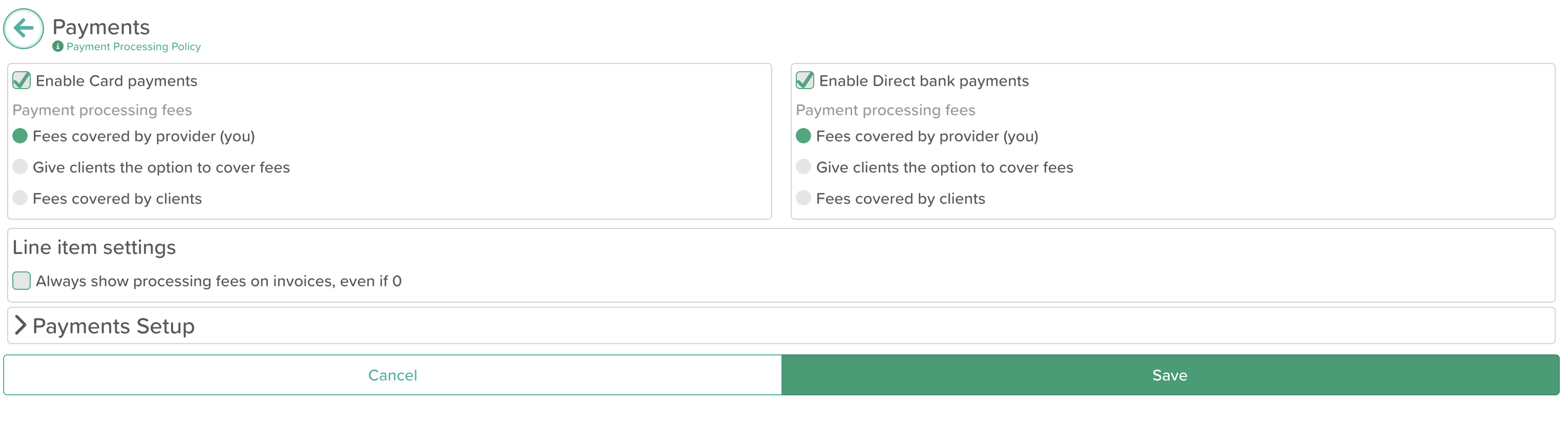
In Billing > Settings > Payments, you can choose which online payment methods to offer and who covers the processing fees.
Enable Card payments: Lets payers pay by credit card, debit card or Google Pay.
Enable Direct bank payments: Lets payers pay by bank account (ACH in the US).
For each payment method, choose who covers the processing fees:
Fees covered by provider (you): Fees are deducted from the payment before it reaches your bank.
Give clients the option to cover fees: Payers can choose whether to add the fee to their payment.
Fees covered by clients: The fee is added to the payer’s total.
Under Line item settings, you can tick Always show processing fees on invoices, even if 0 to show a processing fee line on every invoice.
Click Save to apply your changes.
Note: Invoice PDFs only show a payment link when online payments are enabled.
Collecting an Online Payments
How to Send a the Payment Link for an Individual Invoice
Open the invoice from the Invoices tab.
Click the ellipsis (...) icon and select Email Invoice.
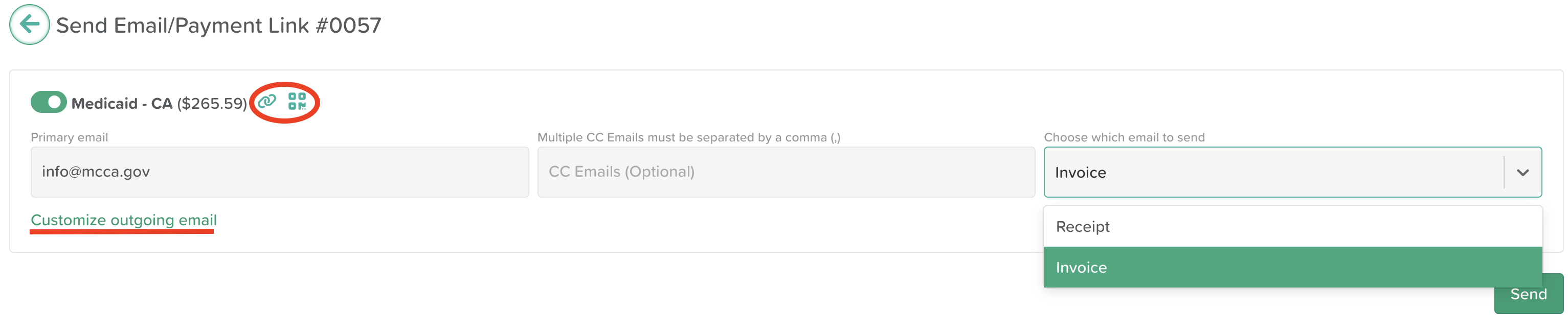
On the Send Email/Payment Link screen, check the payer is toggled on. Their name and invoice amount appear next to the toggle.
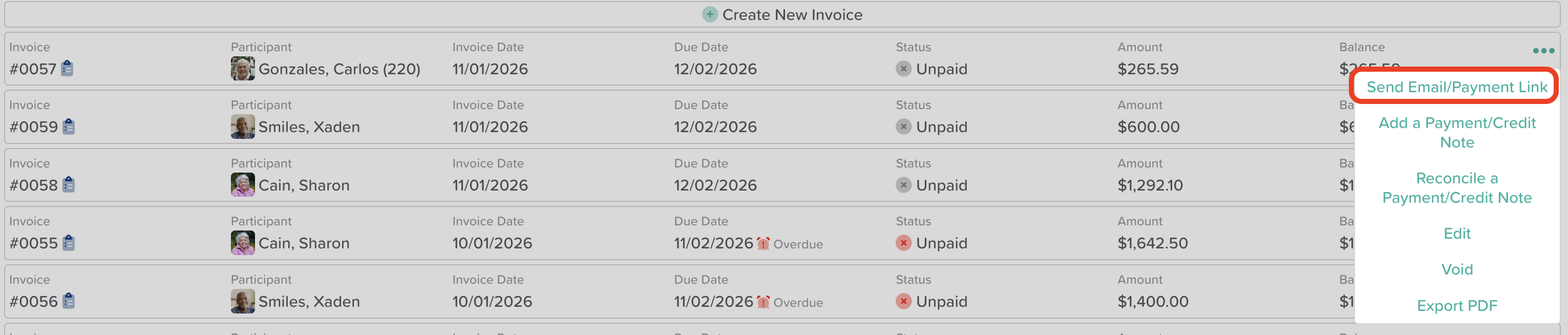
Confirm the Primary email, and add any CC Emails, separated by commas.
Under Choose which email to send, select the email template to use, for example Invoice.
To edit the message for this invoice only, click Customize outgoing email.
Click Send.
You can also share the payment link another way:
Copy the link: Click the link icon next to the payer’s name, then paste it into a text message, email or Storii Messaging.
Share a QR code: Click the QR code icon next to the payer’s name. The payer can scan it to open the payment page.
Share the invoice PDF: Click the ellipsis (...) icon on the invoice and select Export PDF. When online payments are enabled, the PDF includes a View and pay online link.
Sending Invoices in Bulk
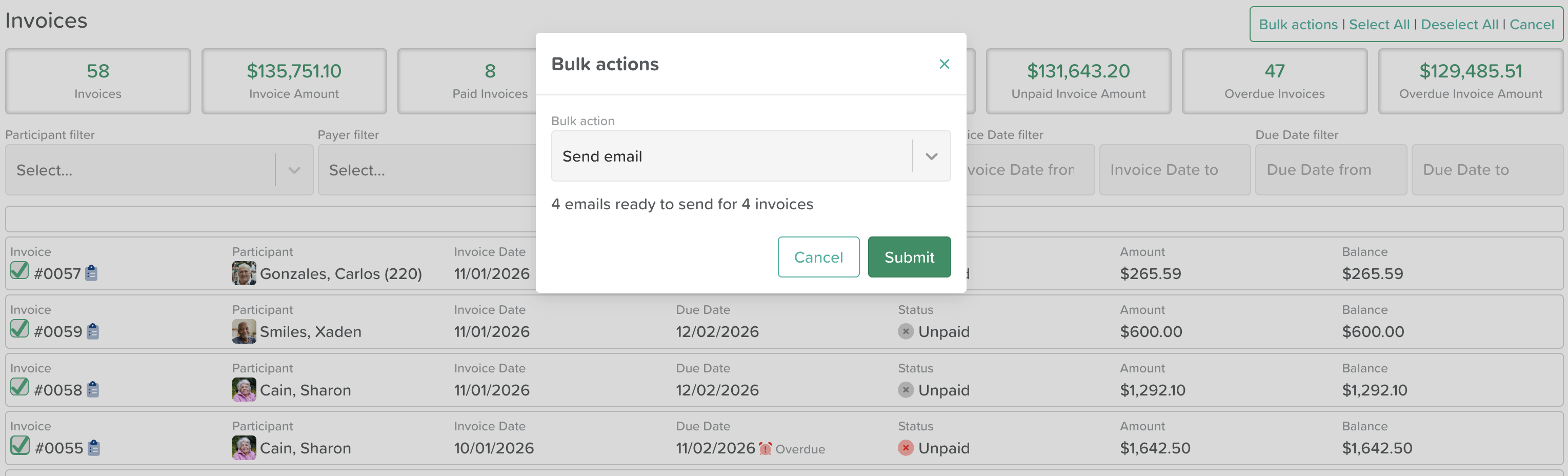
To send many invoices at once, use Multi Select on the Invoices tab.
Then, click on Bulk Actions > Send Email.
To customize your email templates, see How to Customize and Send Email Templates.
What the Payer Sees
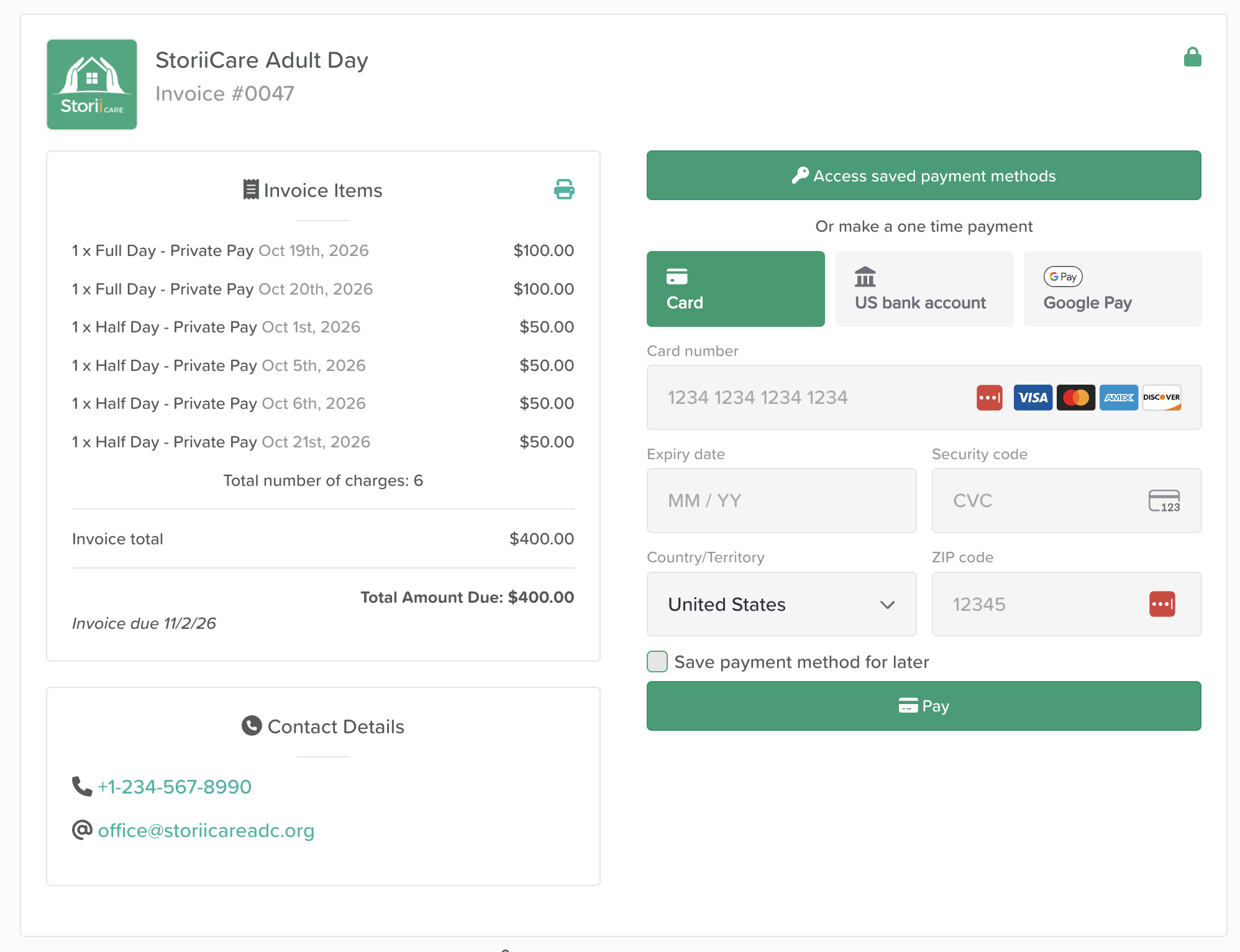
The payment link opens StoriiCare’s secure payment page, which works on any device. It shows:
Your business logo and the invoice number
Invoice Items, with each charge, the invoice total, the amount due and the due date
Contact Details for your business, pulled from Business Settings > Profile
The payment options you’ve enabled
The payer can either:
Click Access saved payment methods to pay with a card or bank account they’ve saved before, or
Make a one-time payment by Card, US bank account or Google Pay. They can tick Save payment method for later to use it again next time.
They then click Pay. Payers can also click Change language at the bottom of the page.
After the Payer Pays
The invoice status updates to Paid once the full amount is processed.
The payer is emailed a receipt automatically. See Payer Receipts.
The payment appears on the Payments tab, reconciled with the invoice.
Note: ACH payments can take several business days to clear. Stripe limits ACH payments to $6,000 per transaction, so larger invoices need to be paid in more than one payment.
Recording a Manual Payment
You can record a manual payment in two places:
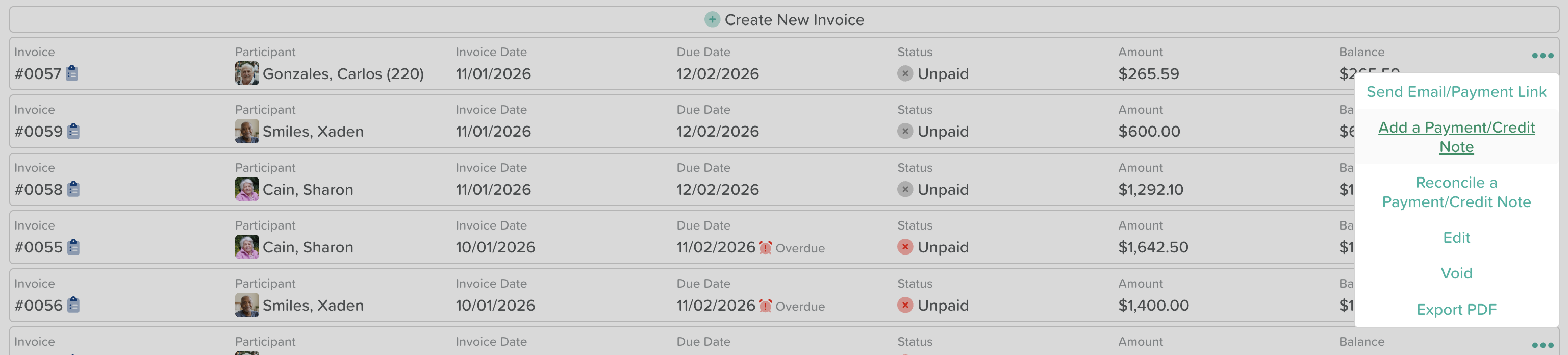
From the invoice: Open the invoice, click the ellipsis (...) icon and select Add a Payment/Credit Note. The payment is reconciled with that invoice automatically.
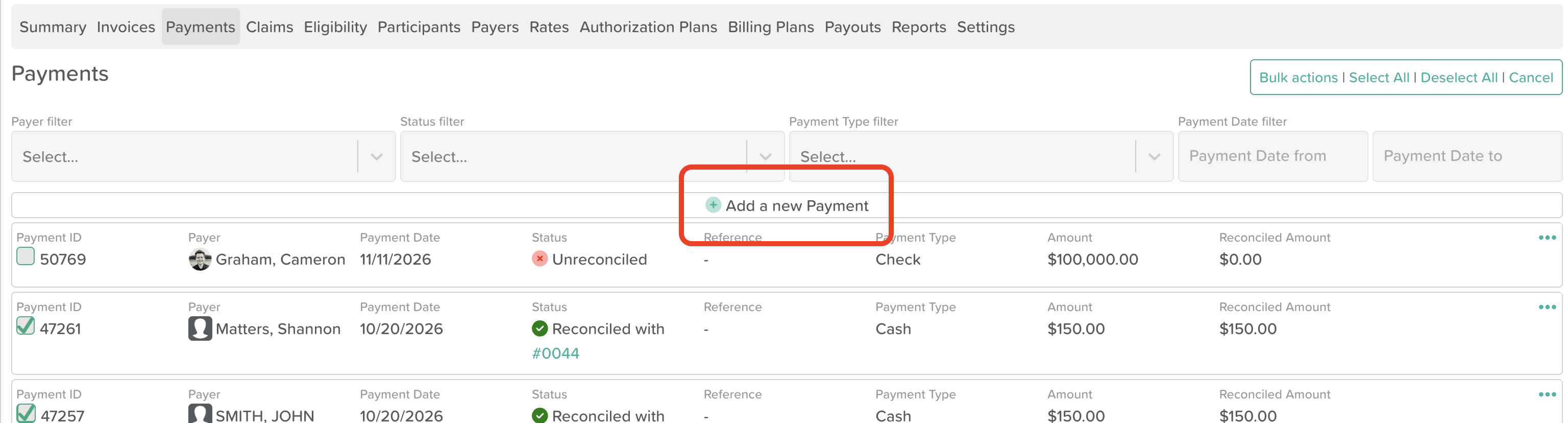
From the Payments tab: Click Add a new Payment. Use this when one payment covers several invoices, such as a monthly agency remittance. You then reconcile it with one or more invoices.
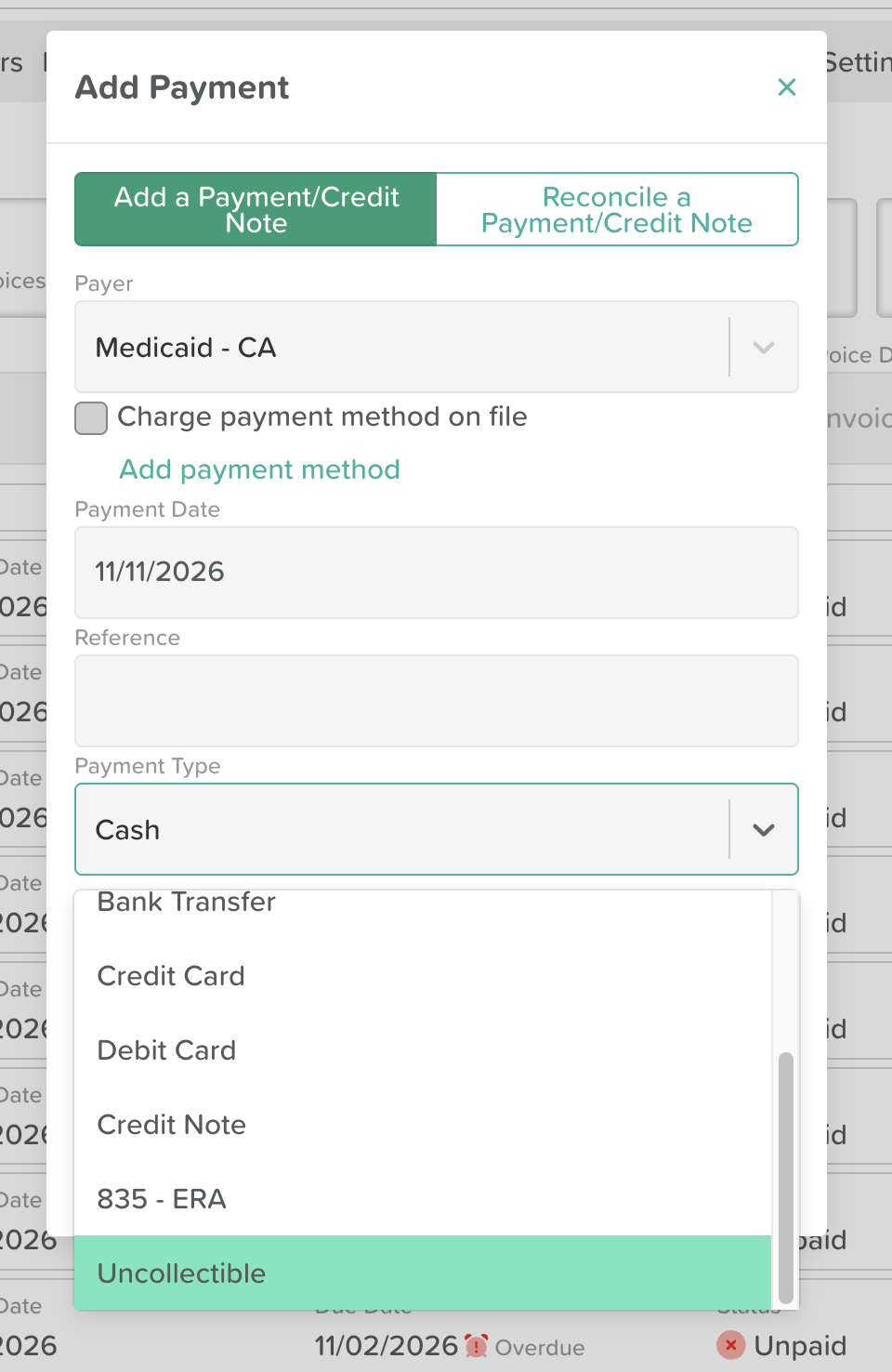
For each payment, enter the amount, payment date, payment type and an optional reference, such as a check number.
For step-by-step instructions, see How to Add a Payment to an Invoice and How to Reconcile a Payment.
Recording an Uncollectible Balance
If you don’t expect to collect part or all of an invoice, record it as a payment with the Uncollectible payment type. This closes out the balance while keeping a clear record that it wasn’t paid.
Managing Payments
The Payments tab lists every payment recorded in StoriiCare, both online and manual.
Each payment shows its Payment ID, Payer, Payment Date, Status, Reference, Payment Type, Amount and Reconciled Amount.
A payment can have one of three statuses:
Reconciled with #[invoice]: The full payment is matched to one or more invoices. Click the invoice number to open it.
Partially Reconciled: Only part of the payment is matched to invoices so far.
Unreconciled: The payment hasn’t been matched to any invoice yet.
Filtering Payments
Use the filters at the top of the tab to narrow the list by Payer, Status, Payment Type or Payment Date range.
Payment Actions
Click the ellipsis (...) icon on any payment to manage it. Depending on its status, you can:
Reconcile it with one or more invoices. See How to Reconcile a Payment.
Unreconcile it from an invoice. See How to Unreconcile a Payment.
Void it. See How to Void a Payment.
View its history. See How to View Recent Actions for Payments.
Uploading an 835 ERA
If you bill insurers electronically, click Upload ERA 835 to import a remittance file and match payments to your claims automatically. See How to Upload an 835 ERA for Claims Remittance.

Viewing Payment Details and Fees
To see the details of an online payment:
Open the invoice on the Invoices tab and find the payment under Payments.
Click Show details under Payment Details.
This shows the payment type, the processing fee and the Net amount, which is what’s paid into your bank account.
To see when funds were deposited into your bank, use the Payouts tab. See A Guide to Payouts.
Costs and Fees
Billing and payments are included in Care Pro and Enterprise StoriiCare plans. Processing fees vary by country and card type.
United States:
Most credit and debit cards: 2.98% + $0.30 per transaction
ACH (bank account): 1%, capped at $10 per transaction
For full details on fees, refunds and disputes, see StoriiCare Payment Processing Policy.
Reporting on Payments
Summary tab: Shows payments collected, collection rate and payment trends for any date range. See A Guide to Billing.
Billing Reports: Track payments and aged receivables by payer. See A Guide to Billing Reports.
Payouts Report: Download transaction data for reconciliation and accounting. See How to Export a Payouts Report.
Need More Help?
Please contact us at support@storii.com