
Setting Up Rates
Rates are the building blocks of billing in StoriiCare. Each rate defines what you charge for, how much you charge, and when the charge applies. Billing Plans use your rates to calculate charges automatically when you generate invoices.
Note: Rates were previously called Services. You may still see “Services” in some older articles, exports and reports.
What Are Rates?
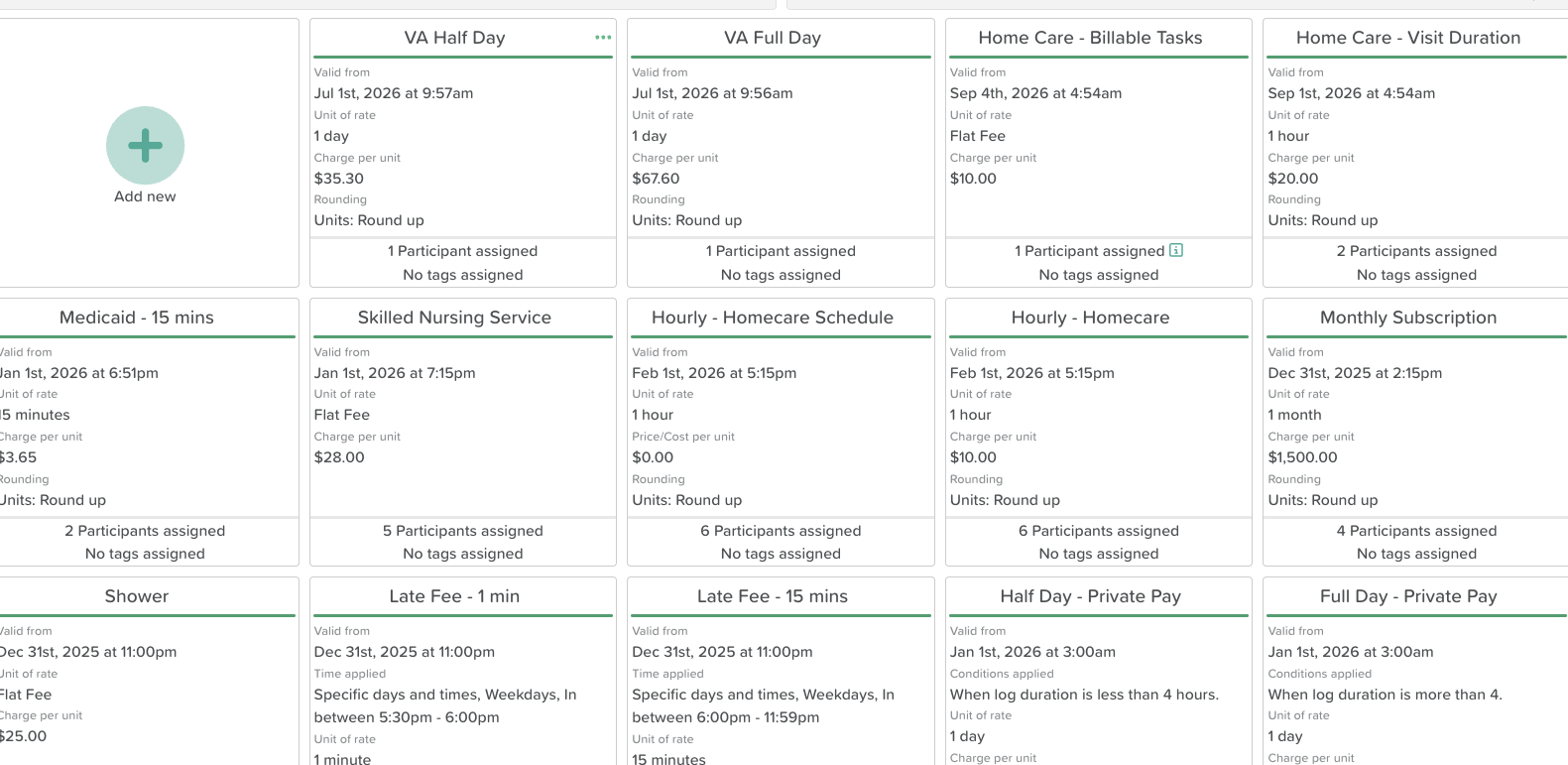
A rate is any billable item. Rates can be based on time, such as 15-minute units or a full day of attendance, or they can be a flat fee, such as a monthly subscription or an assessment fee.
Common examples include:
Attendance: Full day and half day rates
Unit-based care: 15-minute units for Medicaid or Area Agency on Aging programs
Home care: Hourly visit rates or billable tasks
Recurring fees: Monthly subscriptions or memberships
Additional charges: Late pickup fees, showers, skilled nursing services or assessment fees
How Rates Work With Billing Plans
Rates and Billing Plans work together:
The rate defines the charge: its amount, unit, conditions, rounding and who it applies to.
The Billing Plan defines when and how invoices are generated. It also sets which data source each rate pulls from, such as the Participant Register, Attendance Schedule, Home Care Visits or Tasks.
A participant must be assigned to a rate before a Billing Plan can generate charges for them. See Billing Plans.
Checking Rate Calculations Before Invoicing
You can calculate rates in the Attendance Table Export to check figures before you generate invoices.
How to Add a New Rate
From the StoriiCare dashboard, go to Billing and select the Rates tab.
Click Add new.
Complete each field as described below.
Click the Save (disk) icon.
Rate Name
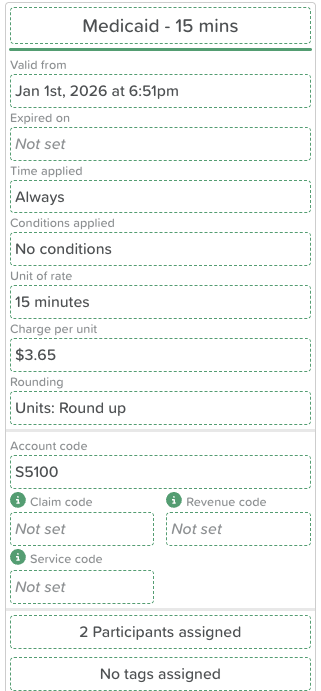
Give the rate a clear name at the top of the rate, for example “Half Day – Private Pay” or “Medicaid – 15 Minutes.” The rate name appears on generated invoices, so use a name your payers will recognize.
Valid From and Expired On
Valid from: The date and time the rate starts.
Expired on: The date and time the rate ends. Leave this blank if the rate doesn’t expire.
Tip: When your prices change, set an Expired on date for the old rate and create a new rate that starts right after it. This keeps your billing history accurate.
Conditions Applied
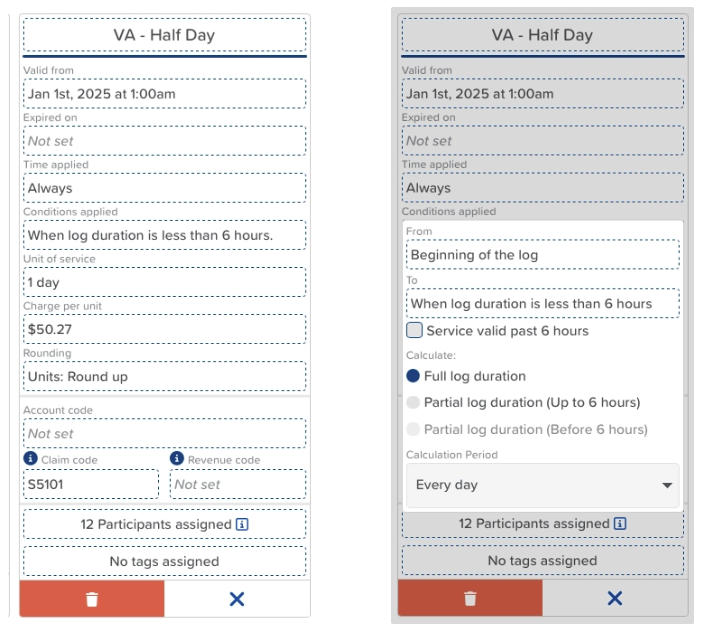
Conditions control which part of a log the rate applies to, based on how long the participant was there. Leave this as No conditions if the rate should apply to every log.
To add a condition:
From: Choose where the condition starts, for example Beginning of the log.
To: Enter the point where the condition ends, for example 6 hours.
Calculate: Choose how the rate is calculated:
Full log duration: The rate is calculated on the whole log.
Partial log duration (Up to X hours): The rate is calculated only on the time up to the point you set.
Partial log duration (Before X hours): The rate is calculated only on the time before the point you set.
Calculation Period: Choose how entries are grouped when the condition is checked, for example Per entry.
On the rate card, conditions are summarized in plain language, for example “When log duration is less than 4 hours.”
See Common Rate Setups below for examples of how conditions work together.
Unit of Rate
Choose the unit the rate is charged in:
Flat Fee: A single charge each time the rate applies, regardless of duration.
Minutes: 1, 5, 10, 15, 20 or 30 minutes
Hours: 1 to 12 hours
Longer periods: 1 day, 1 week, 2 weeks, 1 month, Quarter, Half year or 1 year
Charge per Unit
Enter the amount charged for each unit, for example $3.65 per 15-minute unit or $67.60 per day.
Rounding
Rounding controls how recorded time is converted into billable units. See How Rounding Works below.
Account Code, Claim Code, Revenue Code and Service Code (Optional)
Add any codes your payers or accounting system need. Hover over the i icon next to each field for more detail.
Account code: Used for accounting exports.
Claim code, Revenue code and Service code: Used when submitting electronic claims. See How to Set Up the 837 Export in StoriiCare.
Participants Assigned
Click Participants assigned to select who the rate applies to. Only the participants assigned to a rate are charged for it. See Participant-Specific Settings below.
Tags (Optional)
Click No tags assigned to add Schedule or Register tags to the rate. Use tags to link a rate to specific entries. For example, a “Make Up Day” tag can be used to bill make-up attendance at a different rate.
How Rounding Works
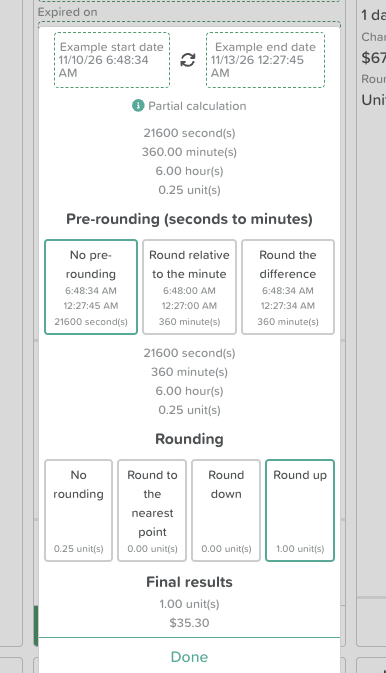
Rounding happens in two stages: pre-rounding, which converts seconds to minutes, and rounding, which converts minutes into whole units.
Click the Rounding field to open the rounding options.
Test Your Rounding
At the top of the pop-up, enter an Example start date and Example end date. As you select different options, StoriiCare shows the time and units at each stage. The Final results at the bottom show the number of units and the amount charged.
Stage 1: Pre-Rounding (Seconds to Minutes)
No pre-rounding: Uses the exact time, including seconds.
Round relative to the minute: Drops the seconds from both the start and end times before calculating. For example, 6:48:34 becomes 6:48:00.
Round the difference: Calculates the exact time between sign-in and sign-out, then rounds it to the minute.
Stage 2: Rounding (Minutes to Units)
No rounding: Bills partial units. For example, 6 hours on a 1-day rate bills 0.25 units.
Round to the nearest point: Rounds to the nearest whole unit. On a 15-minute unit, 7 minutes rounds down to 0 units and 8 minutes rounds up to 1 unit.
Round down: Always rounds down to the last full unit.
Round up: Always rounds up to the next full unit. For example, 6 hours on a 1-day rate bills 1 full unit.
Example: A participant attends for 42 minutes and is billed in 15-minute units. With Round up, 42 minutes becomes 45 minutes, which is 3 units.
Tip: Most rates use Round relative to the minute for pre-rounding. Seconds rarely matter for billing, and dropping them prevents unexpected rounding results.
Participant-Specific Settings
Each participant on a rate can have their own settings. To open them:
Open the rate in edit mode and click Participants assigned.
Click No specific settings under the participant’s name.

Validity Dates and Days
Set when a participant is eligible for this rate:
Valid From and Valid To: Useful if a participant is approved for a rate partway through a month, or their approval ends on a specific date.
Days and times: Limit the rate to specific days or times, for example Mondays and Fridays only.
No charges are calculated for dates, days or times when the participant isn’t eligible.
Rates with participant-specific settings show an i icon next to the number of assigned participants. Click the i icon to see a summary of each participant’s settings.
Invoice Splitting Between Payers
If Authorization Plans is enabled for your account, invoice splitting is set up here, on each rate. This lets you split each rate differently for the same participant. For example, a family member and a bursary share a 60% - 40% split on attendance charges.
Scroll to the bottom of the participant’s settings and click No rules set (everything goes to Default Payer).
Click Add a rule and set each payer’s share as a fixed amount, a percentage or Pays the rest.
Use Show breakdown to preview the split.
For full instructions and examples, see How to Set Up Invoice Splitting Between Payers.
Common Rate Setups
Half Day and Full Day Rates
Charge a half day rate for shorter attendance and a full day rate for longer attendance. Create two rates:
Half Day: Unit of rate 1 day, with the condition “When log duration is less than 4 hours.”
Full Day: Unit of rate 1 day, with the condition “When log duration is more than 4 hours.”
Add both rates to the same Billing Plan. StoriiCare applies the correct rate based on how long the participant attended each day.
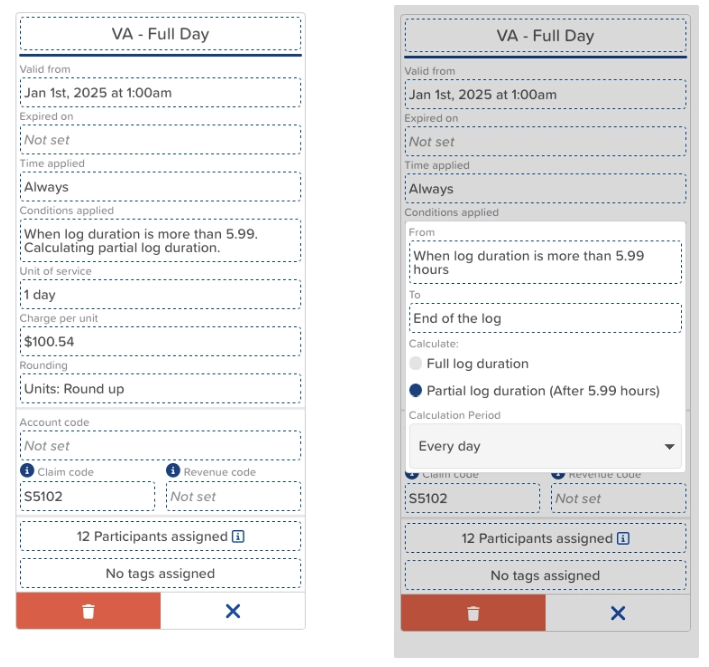
Flat Fee Plus 15-Minute Units (Medicare 8-Minute Rule)
Some payers, including many Medicaid programs, bill a flat fee for a set block of time plus 15-minute units for any time beyond it. Under the 8-minute rule, 1 to 7 extra minutes bill nothing, and 8 or more extra minutes bill a full unit.
Create two rates:
Rate 1: Flat fee for the first block (for example, a half day up to 4 hours)
Unit of rate: Flat Fee
Condition: From Beginning of the log to exactly 4 hours
Turn on the valid past toggle so the flat fee still applies when the participant stays longer than 4 hours.
Rate 2: 15-minute units for time beyond the block
Unit of rate: 15 minutes
Condition: Applies only to time over 4 hours
Pre-rounding: Round relative to the minute
Rounding: Round to the nearest point
You don’t need a separate condition for the 8-minute rule. Combining Round relative to the minute with Round to the nearest point handles it automatically.
Important: Always set the cutoff to an exact time, such as 4 hours, not 3.99 hours. 3.99 hours is 3 hours, 59 minutes and 24 seconds, so the 15-minute rate would start counting 36 seconds early. That can push 7 extra minutes over the rounding point and bill a unit that shouldn’t be charged.
Before going live, test the setup on a test participant and check that the invoice matches the expected charge:
Time at center | Expected charge |
|---|---|
3h 50m | Flat fee only |
4h 00m | Flat fee only |
4h 07m | Flat fee + 0 units |
4h 08m | Flat fee + 1 unit |
4h 22m | Flat fee + 1 unit |
4h 23m | Flat fee + 2 units |
Late Pickup Fees
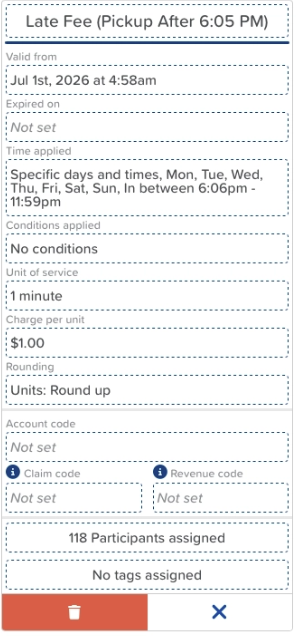
Per-minute late fee: Charge $1 per minute when a participant is still signed in after 6:05 p.m.
Unit of rate: 1 minute
Charge per unit: $1.00
Time applied: Specific days and times, for example weekdays from 6:05 p.m. to 11:59 p.m.
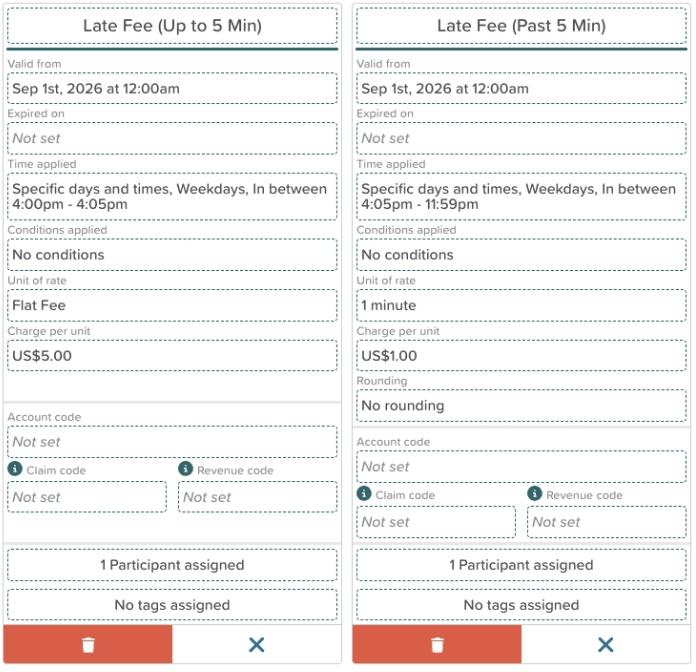
Flat fee plus per-minute late fee: Charge a $5 flat fee for pickups between 4:00 and 4:05 p.m., plus $1 for each minute after 4:05 p.m. For example, a 4:03 p.m. pickup is charged $5 and a 4:10 p.m. pickup is charged $10.
Create two rates:
Late fee (flat): Unit of rate Flat Fee, $5.00, with Time applied set from 4:00 p.m.
Late fee (per minute): Unit of rate 1 minute, $1.00, with Time applied set from 4:05 p.m.
Add the late fee rates to the same Billing Plan as your attendance rates. Late fees are itemized separately on invoices.
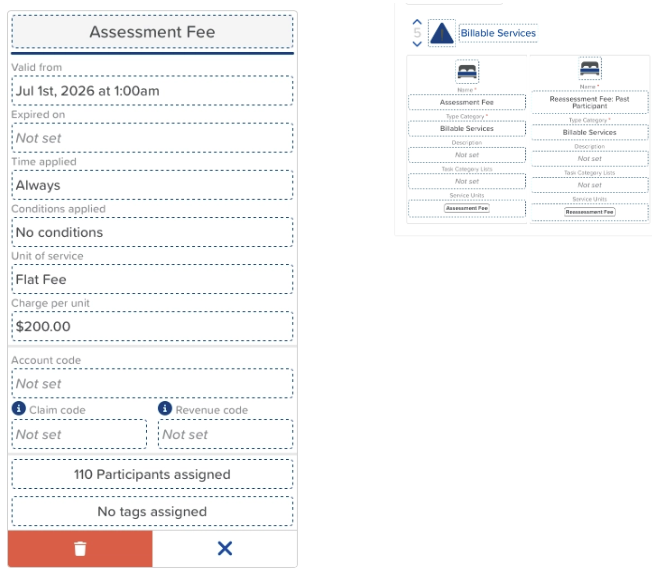
Assessment Fees and Other Billable Tasks
To charge a one-off fee such as an assessment fee:
Create a rate with the unit of rate Flat Fee, for example “Assessment Fee – $150.00.”
Create a billable task and link the rate to it. See A Guide to Using Tasks.
In the Billing Plan, include Tasks as a data source for that rate.
The fee is charged each time the task is completed for a participant.
Make-Up Days
If participants pre-pay for a set number of days each month and can make up missed days later, create a Flat Fee rate at $0.00 and assign it a “Make Up Day” tag. Make-up attendance logged with that tag is recorded without an extra charge.
How Time-Based Rates Appear on Invoices
When a rate is billed in units, the invoice line shows the total number of units multiplied by the rate per unit. It doesn’t show a single session charge or a breakdown in hours and minutes.
Example: A participant attends for 6.5 hours, billed in 15-minute units at $6.64 per unit. The invoice line shows:
Quantity: 26 (units)
Rate: $6.64
Amount: $172.64

No further rounding is applied on the invoice beyond the rounding set on the rate.
Troubleshooting
A unit is being charged that shouldn’t be
Check the cutoff. Make sure conditions use exact times, such as 4 hours, not 3.99.
Check pre-rounding. Make sure Round relative to the minute is selected so seconds are dropped.
Check the Billing Plan. If the plan uses its own rounding setting, it may be applied as well as the rate’s rounding.
Check the invoice line. If a unit-based rate shows the full day’s time instead of just the time beyond the cutoff, contact support@storii.com.
A participant isn’t being charged for a rate
Check that the participant is assigned to the rate.
Check the participant’s specific settings, such as their validity dates and eligible days.
Check the rate’s Valid from, Expired on and Time applied settings.
Check that the rate is included in the participant’s Billing Plan, with the correct data source.
Editing, Duplicating and Deleting Rates
To edit a rate: Hover over the rate, click the ellipsis (...) icon and select Edit.
To copy a rate: Click the ellipsis (...) icon and select Duplicate. This is useful when you’re creating a similar rate, such as a new year’s pricing.
To delete a rate: Open the rate in edit mode and click the trash icon.
Note: Changes to a rate only affect charges calculated after the change. Invoices you’ve already generated aren’t updated.
Related Articles
Need More Help?
Please contact us at support@storii.com